
I recently wrote about the deep-seated human physiological battle to change. How our brains are wired to resist what feels foreign or uncomfortable as a way to protect us from imminent perceived or actual danger. But while resistance to change isn't anything new, the pace of change in our emerging AI-everything world of work is unprecedented. Meaning the luxury of a slow shift from resistance, to compliance through to eventual commitment no longer serves great teams and winning companies. Swift adaptation and sustained adoption are critical factors in success.
Because here's the thing: the companies winning right now aren't the ones who roll out the slickest new AI tool or send the longest all-staff memo. They're the ones who know that resistance is part of the package. Design for it.
From Compliance to Commitment: A Leader's Lens
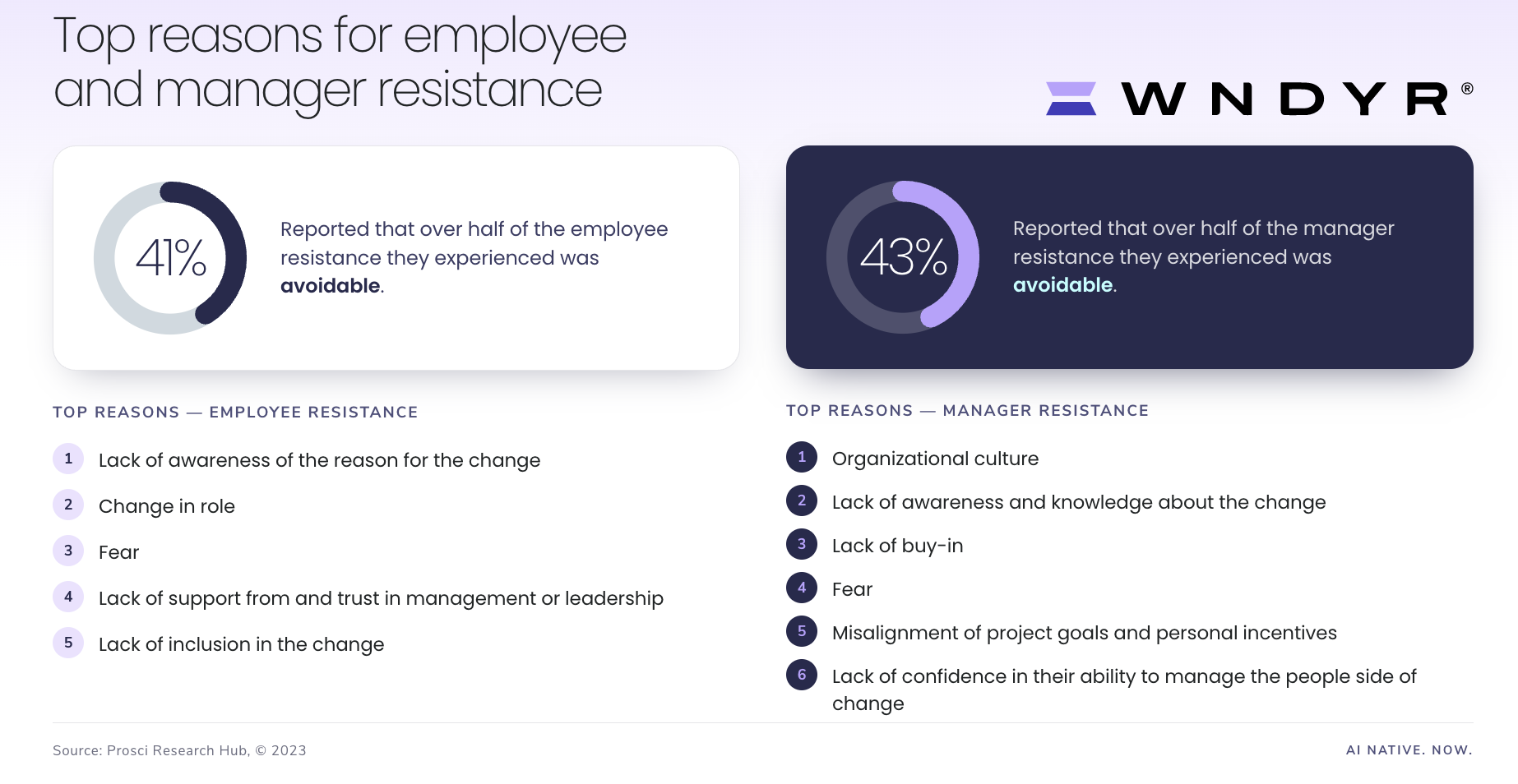
This is where the ADKAR model earns its keep. Prosci's framework breaks change into five stages — Awareness, Desire, Knowledge, Ability, and Reinforcement. Skip a stage, and resistance shows up exactly where the data above says it will: unclear reasons for the change, and managers who don't feel equipped to lead it.
This is the gap WNDYR closes. Change management isn't a checkbox we tack onto an AI rollout; it's built into how we deliver AI Native Transformation from day one.
The biggest trap leaders fall into is mistaking compliance for commitment. Employees might nod along in meetings, attend the training, even click through the shiny new workflow tool. That doesn't mean they've bought in.
The MIT State of AI in Business 2025 Report found this exact gap: executives are bullish on AI adoption, but employees on the ground? Not so much. Leaders are seeing "the what," but missing "the why."
This is where the concept of a profound discovery, a true "aha!" or Eureka moment, becomes so critical. Mel Kiley of Create Consulting introduced me to the Your Brain at Work framework, which explains that long-lasting change has to move beyond simple directives. It must tap into a deeper layer of personal understanding and ownership.
She shared this Your Brain at Work podcast episode, which outlines five levels of mastery that culminate in this exact kind of breakthrough. For true, sustainable change to take hold, individuals need a profound insight that transforms their understanding and enables a higher level of mastery over the change. It's the journey from the surface-level mechanics of a new process to a deep, personal realization of its value. We'll explore this more in a dedicated post, but for now, here are the five levels for your brain to process and connect the dots:
- Compliance — Simply doing what you're told.
- Capability — Learning how to perform the new task.
- Confidence — Feeling comfortable with the new process.
- Creativity — Finding new and better ways to use the change.
- Commitment — The Eureka moment where the new way of working becomes a profound personal value, not just a rule.
Real-World Examples: Bad → Good → Better
Let's make this practical. Here's how change resistance plays out in today's workplace, and how leaders can either fuel it or flip it.
Example 1: AI in Customer Service
- Bad: Leadership drops an AI chatbot into the call center and says, "Use this now." Agents fear redundancy. Morale tanks.
- Good: Leaders train agents on how the bot reduces admin time. Resistance softens, but agents still feel like they're "feeding the machine."
- Better: Leaders co-design scripts with agents, highlight where AI frees them for deeper customer conversations, and celebrate human wins alongside AI metrics. Agents feel proud, not replaced.
Example 2: AI-Powered Workflow Automation
- Bad: Leadership rolls out an AI tool that auto-assigns tasks and flags workload with zero team input. People feel managed by an algorithm. Trust erodes fast.
- Good: Leaders explain how the tool balances workload and cuts admin time. Compliance improves, but people still feel watched, not helped.
- Better: Leaders let teams tune the tool's rules, show exactly where it's freed up hours for higher-value work, and share the wins publicly. The tool becomes a teammate, not a taskmaster.
Example 3: AI-Generated Performance Dashboards
- Bad: New AI-driven dashboards go live overnight, flagging productivity dips nobody understands. Stress spikes. People assume they're being watched, not supported.
- Good: Leaders explain what the metrics mean and run training on the dashboard. People adjust, but adoption feels like a chore.
- Better: Leaders connect the AI-generated insights to individual growth and company purpose, and co-create how the metrics get used with teams. Suddenly the numbers aren't just management's, they're ours.
The difference? Moving from a rollout to people, to a rollout with people.
The Forward-Thinking Leader's Playbook
Resistance isn't a problem to eliminate. It's a signal. A chance to dig deeper, to reframe, to invite people into ownership. Leaders who lean into that truth turn resistance into resilience.
Provocative Questions to Ponder:
- Are you designing change for people, or with them?
- What would it take for your team to move from compliance to commitment?
- Do your employees know why this change matters for them, or just for the company?
Practical Next Actions:
- Spot the Resistance Early — Treat pushback as data, not defiance.
- Co-Create the Process — Involve the people doing the work, not just the people funding it.
- Build for Mastery — Help teams climb from compliance to commitment. Don't stop at capability.
- Celebrate the Human Wins — Make visible how the change improves people's day-to-day, not just the company's bottom line.
Change isn't going anywhere. But if we learn to win the war on resistance, not by overpowering it, but by transforming it, we move from just surviving change to thriving in it.
If your team's stuck between compliance and commitment, that's the work we do. Our change management approach is built into every AI Native Transformation engagement, not bolted on after launch.
This is just the tip of the iceberg. Our third and final post in this series will explore how a COO and CPO can use data and AI itself to build a resilient, future-ready organization, embracing the very tools that spark our deepest fears.